
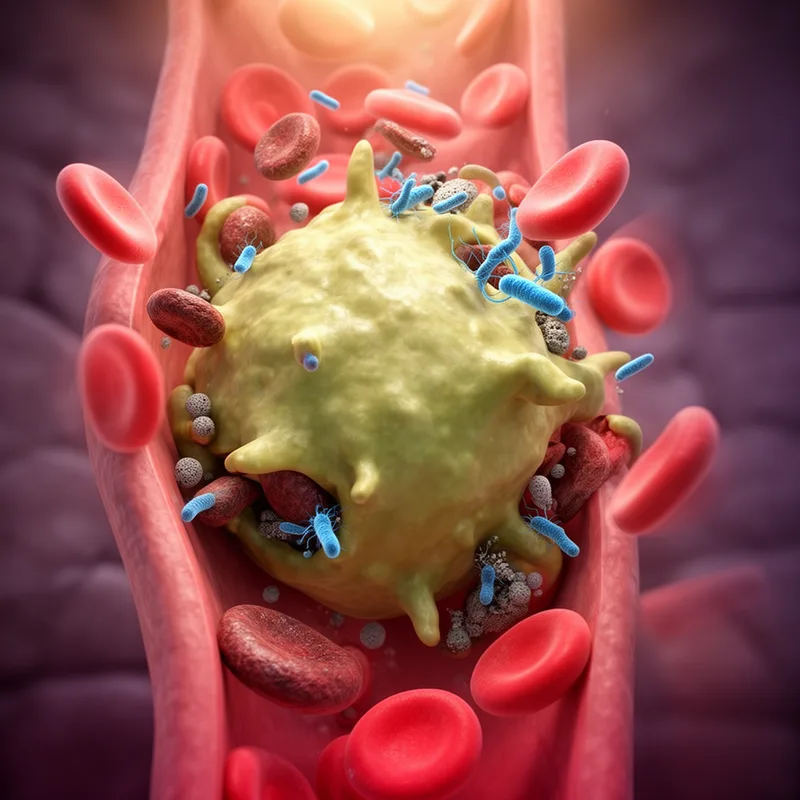
Kupffer's cell


 1
8.1
- noun
- /ˈkʌpfərz sɛl/
- Specialized
- The Kupffer's cell destroys old blood cells and foreign particles in the liver.
Examples
-
Did you know that a Kupffer's cell can engulf bacteria?
-
Scientists observed a significant increase in Kupffer's cell activity following liver injury.
-
Kupffer's cell plays a crucial role in filtering harmful substances from the bloodstream in the liver.
-
The destruction of old red blood cells is one of the key functions of the Kupffer's cell.
-
A Kupffer's cell plays a crucial role in the immune response.
-
Researchers studied how Kupffer's cell activity increases during infections.
-
A Kupffer's cell is essential for maintaining a healthy immune response in the body.
Synonyms
 6
6.7
A large white blood cell that eats and removes germs and dead cells
 1
5.8
A tiny part of the body that eats dead tissue and germs to help fight infection
Surface Forms
Morphology
Kupffer's + cell
This is an eponymic term: 'Kupffer's' is a proper name and carries no descriptive meaning a B1 learner could combine with 'cell' to infer 'a specialized liver phagocytic cell'. While 'cell' is transparent, the possessive name does not indicate function or location, so knowledge of the constituents is insufficient. The sense requires domain-specific/encyclopedic knowledge rather than compositional inference, making it opaque to learners.
Etymology
Kupffer's cell is named after a doctor, Karl Kupffer, who first saw these cells in the liver. Think of Kupffer as a guard and cell as its tool that 'eats' bacteria and old red blood cells, so the name points to a cell that 'cleans' the blood.