
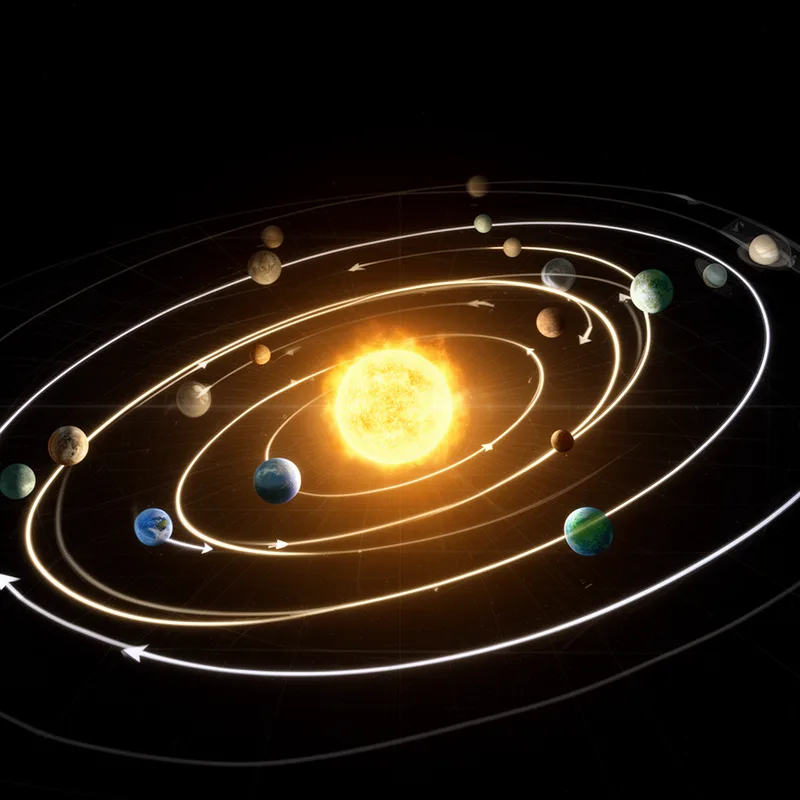
Kepler's law of planetary motion
- noun
- /ˈkɛplərz lɔː ʌv ˈplænɪtɛri ˈmoʊʃən/
- Specialized
- According to Kepler's law of planetary motion, planets move in elliptical orbits around the Sun.
Examples
-
Scientists can predict the positions of planets using Kepler's law of planetary motion.
-
The explanation of Mars's orbit was greatly improved after the discovery of Kepler's law of planetary motion.
-
Did you know about Kepler's law of planetary motion?
-
According to Kepler's law of planetary motion, planets move in elliptical orbits.
-
According to Kepler's law of planetary motion, planets move in elliptical orbits around the Sun.
-
Scientists can predict the positions of planets using Kepler's law of planetary motion.
-
The explanation of Mars's orbit was greatly improved after the discovery of Kepler's law of planetary motion.
Synonyms


 1
7.4
1
7.4
A rule that describes how planets move around the Sun
Surface Forms
Morphology
Kepler's + law + of + planetary + motion
The phrase composes a possessive name with 'law' and 'planetary motion', so a learner who knows 'law', 'planetary' and 'motion' can infer it refers to a scientific rule describing the movement of planets even if they do not know who Kepler was. This possessive + noun composition is a regular, compositional pattern found cross‑linguistically, making the overall meaning recoverable from the constituents.
Etymology
Kepler's law of planetary motion comes from the astronomer Kepler, who looked closely at planet observations and found simple 'rules' about their movement. He saw that planets travel in oval paths and change speed, so the name now means the three 'rules' scientists use to predict where planets will be.