
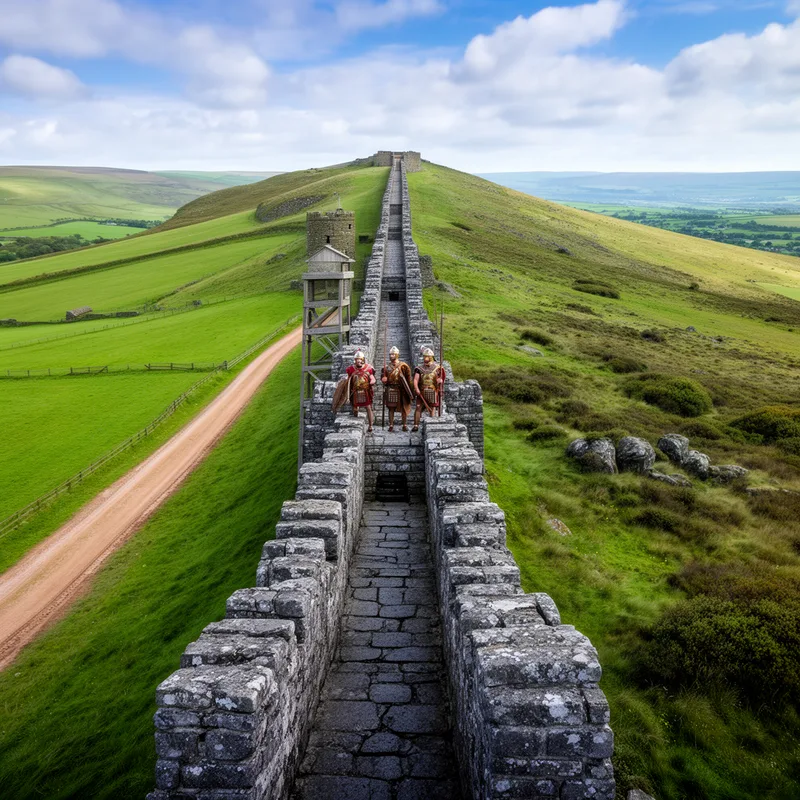
Hadrian's Wall
 1
6.9
1
6.9

- proper noun
- We know from archaeological evidence that the Romans did grow grapes as far north as Hadrian's Wall. We have found traces of their vineyards, the pips in the rubbish heaps, and the like, as well as some written references.
- the long Hadrian's Wall
Examples
-
The Romans grew grapes up to Hadrian's Wall (and without modern varieties) - Vindolanda.
Blog text (14) -
A border wall would be more akin to the Great Wall of China, or Hadrian's Wall in England.
Blog text (9) -
Head north to Hadrian's Wall.
-
Race ya to Hadrian's Wall!
-
Today you cannot grow grapes in England further north than about 200 miles south of Hadrian's Wall.
Blog text (14) -
That's why the Romans built Hadrian's Wall, or the Chinese built their Great Wall.
Blog text (1) -
Many tourists visit Hadrian's Wall to explore its historical significance and stunning views.
-
The stunning landscape surrounding Hadrian's Wall attracts hikers and history enthusiasts alike.
-
During our trip to England, we planned a day to walk along Hadrian's Wall and learn about its history.
Surface Forms
Morphology
Hadrian's + wall
The phrase is a straightforward possessive construction: a B1 learner who knows the constituents can infer it denotes a wall associated with Hadrian (i.e., 'Hadrian's wall'). However, the specific historical meaning — that it is a Roman defensive boundary built under Emperor Hadrian in the 2nd century — requires extra world knowledge and is not predictable from the words alone.
Etymology
Hadrian's Wall gets its name from the Roman emperor Hadrian, who ordered a long wall across northern Britain to keep out people from the north. Today the wall's ruins still 'mark' the border of Roman Britain, so the name reminds us it was built as a frontier.