
Euclid's fifth axiom
- noun
- /ˈjuːklɪdz fɪfθ ˈæksaɪəm/
- Specialized
- The uniqueness of parallel lines is guaranteed by Euclid's fifth axiom in classical geometry.
Examples
-
Non-Euclidean geometry emerges when Euclid's fifth axiom is replaced or modified.
-
According to Euclid's fifth axiom, parallel lines never meet.
-
Many mathematicians attempted to prove Euclid's fifth axiom using the other axioms, but failed.
-
Many mathematicians rely on Euclid's fifth axiom for proofs.
-
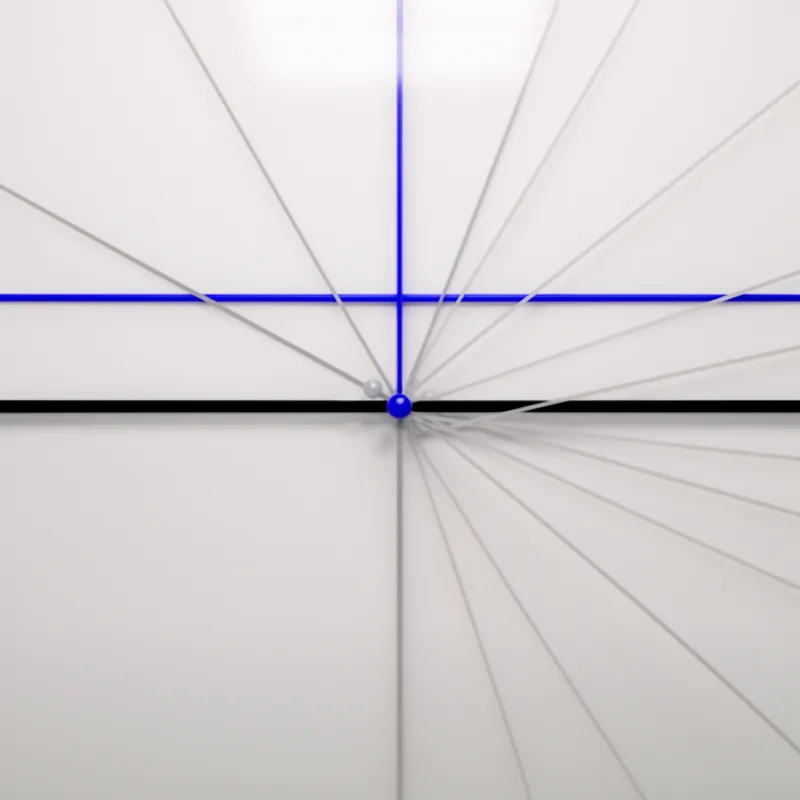
The concept of parallel lines is defined by Euclid's fifth axiom, which states that through any point not on a given line, there is exactly one line parallel to it.
-
In Euclidean geometry, Euclid's fifth axiom ensures that parallel lines remain equidistant and never intersect.
-
Educators often illustrate the importance of Euclid's fifth axiom when teaching the properties of parallel lines.
Synonyms

In geometry, only one line through a point not on a given line does not meet it
Surface Forms
Morphology
The phrase is compositionally clear: a learner who knows 'Euclid's' as a possessive name, 'fifth' as an ordinal, and 'axiom' as a fundamental statement will understand this refers to the fifth fundamental statement attributed to Euclid. However, the specific geometric content (the parallel postulate about lines) is technical background knowledge, so the exact meaning is not derivable from the constituents alone.
Etymology
Euclid's fifth axiom is named after the ancient Greek mathematician Euclid, who imagined a simple picture: a straight line and a point not on it, and he said there is exactly one straight line through that point that never meets the first line. So the name stands for the rule that there is 'only one' 'parallel' line through the point.

