

Euclid's axiom


 1
8.6
1
8.6
- noun
- /ˈjuːklɪdz ˈæksɪəm/
- Specialized
- In his work, Euclid introduced Euclid's axiom, which is fundamental to the rules of geometry.
Examples
-
Euclid's Axioms
Blog text (7) -
To understand geometry, you need to study Euclid's axiom that states a straight line can be drawn between any two points.
-
Many mathematical proofs rely on Euclid's axiom regarding parallel lines.
Synonyms
 30
7.5
30
7.5
A basic statement accepted as true and used as a starting point for reasoning

A basic rule of geometry on a flat surface used to build proofs
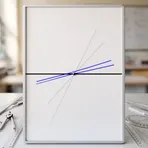
One of the five basic rules that make Euclidean geometry
Surface Forms
Morphology
Euclid's + axiom
The phrase is compositionally formed from the possessive proper name 'Euclid's' and 'axiom' (a fundamental statement), so a learner who knows both constituents can deduce it refers to a fundamental statement attributed to Euclid (i.e., in Euclidean geometry). Specific historical or technical details (who Euclid was, the five axioms) are extra knowledge, but the basic referential meaning is directly derivable from the parts.
Etymology
Euclid's axiom comes from Euclid, a Greek teacher long ago who began geometry with a few plain statements about straight lines and points. These 'starting rules' were used to build all other ideas in geometry, so the phrase means a basic rule or 'starting point' for reasoning.